
Wallpapering is one of the important stages in completing repairs in an apartment, house or office. It is how professionally these works will be done that determines the final appearance, since the wallpaper is always in sight and “strikes” from the first seconds you enter the room. Our company provides services for wallpapering in the Dnieper, Kyiv, Kharkov, Odessa. Our designers will help you choose the type of wallpaper, select the pattern, tone, texture, and correctly calculate the number of rolls. Wallpapering takes an average of one day per room, provided the walls are prepared.
Wallpapering price
| Types of jobs | Price | Unit. |
| Wallpapering on a non-woven base (without pattern selection) | 50 | m 2 |
| Wallpapering on a non-woven basis (with selection of a pattern) | 55 | m 2 |
| Wallpapering on paper basis | from 70 | m 2 |
| Pasting of textile wallpapers | 100 | m 2 |
| Pasting 2-level wallpaper | 50 | m 2 |
| Pasting photo wallpaper | 100 | m 2 |
| Applying liquid wallpaper | 95 | m 2 |
Prices for wallpapering depend on: ceiling height, type of material, number of rolls.
If you need additional services for wall finishing and preparing them for wallpapering, we are also ready to provide them. The work is carried out only by highly qualified employees with extensive work experience who have diplomas of qualification, officially arranged in the company, observing the conditions and regulatory requirements for this type of work.
Price for additional work
| Removal (dismantling) of wallpaper | 15-20 | m 2 |
| Wall putty for wallpaper | 80 | m 2 |
| Sticking fiberglass | 45 | m 2 |
| Painting wallpaper in two layers | 50 | m 2 |
| Painting the ceiling in two layers | 60 | m 2 |
| Wallpaper frieze | 10 | m.p. |
How to order wallpapering from us
You leave a request or call the master at +380000000 or through the form to order a call on our website.
After agreeing on the cost, terms and conclusion of the contract on the appointed day, the master leaves for you and begins to carry out the work.
What to look for when buying wallpaper
- An important point that you need to pay attention to first of all is the series and batch number of the wallpaper. The numbers on all rolls must be the same, otherwise there may be a difference in color and brightness;
- There are wallpapers where there is a pattern combination - a report, but there is where there is no report, so when buying it is important to pay attention to this, otherwise the number of wallpapers at the end of the sticker may not be enough;
- Carefully study the quality certificates and the manufacturer's label on a roll of wallpaper, which usually indicate: comprehensive information about environmental friendliness, air permeability, density, brand of glue to be used, serial number of the product, in which direction the pattern is directed, how to apply glue (on the wall, on wallpaper or wallpaper already has an applied layer of glue), pattern repeat, light fastness, type of wallpaper (washable wallpaper, canvases for painting or others);
How to do your own wallpapering
If you yourself decide to carry out a set of works, you need to take into account a few recommendations for preparing walls for wallpapering. Walls, partitions, ceilings, can be made of plasterboard sheets (gypsum board) or plastered.
If the walls are made of drywall, they must necessarily have sealed seams, puttied and primed in a light tone, otherwise the inscriptions on the drywall and the dark color will appear on the wallpaper canvases that have a thin base, and not primed drywall intensively absorbs moisture from the glue, which always leads to premature drying of the adhesive and poor adhesion. Self-tapping screws used for fastening must be recessed by 2-5 mm and puttied, otherwise they will begin to rust and this will appear on the finish. In the future, problems may also arise with the removal of old wallpaper from the walls, if the plasterboard walls were not plastered and primed during the first gluing.
If the work is planned for plastered walls, there are also points that you need to pay attention to. If the material is cement-based, it will have a granular rough structure, so it is not recommended to stick wallpaper without preliminary preparation (primer), as the surface structure may appear.
If the walls are plastered with a gypsum base and not primed, then in this case it is also not recommended to carry out work on stickers, since gypsum has the ability to absorb moisture, so you will not succeed in gluing wallpaper on this base with high quality and you will probably have to glue the canvases in places lagging behind the walls or completely re-glue.
Step-by-step instructions on how to stick wallpaper yourself
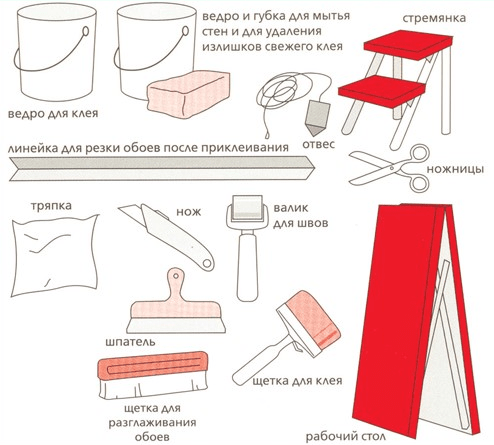 List of tools that you will probably need:
- ladder;
- tray or basin for glue;
- stationery knife or scissors;
- a plastic spatula or a wide rubber roller - for squeezing air out from under the wallpaper;
- rubber roller, small - for smoothing in the corners;
- brush / roller for glue;
- ruler long and tape measure;
- pencil;
- level or plumb;
- clean, soft cloths - to remove excess glue;
IMPORTANT! On paper and vinyl wallpapers, glue is applied directly to the canvas, and when gluing non-woven wallpaper, only walls are treated with glue.
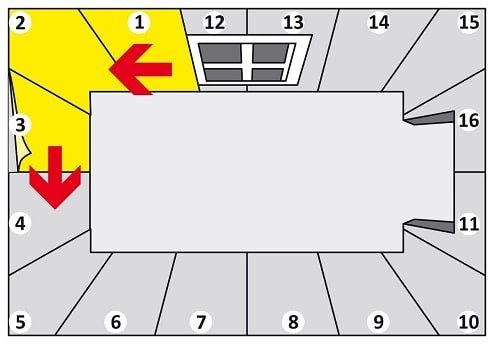
- Wallpaper is glued in a circle, one strip after another, usually starting from a window or other opening, but this is not necessary.
- In order for all the pasted strips to be held perfectly vertically, it is necessary to make accurate marks for the first canvas using a plumb line or level (this will insure you against distortions).
- If you use plain wallpaper, you can immediately cut them to the desired height for the entire room, which will slightly speed up the gluing process, it is important to do the cutting on a clean surface.
- When cutting wallpaper with a pattern, it is better not to rush and cut it gradually, checking whether the pattern matches.
- To cut a piece of wallpaper from a roll, you first need to measure the desired length and add a few centimeters for an overlap, this will give you more freedom when fitting the wallpaper.
- The next step is the preparation of the glue. Be sure to follow the instructions on the package, which indicate the required amount of water, the time it takes for the glue to gain its properties, the method of application, etc.
- As a standard, they start gluing from the ceiling and move towards the floor, evenly smoothing the canvas from the center to the edges. The roller must be clean so as not to leave marks, the process of squeezing out air occurs until all the bubbles are filled.
- The weak point is the joints (which can open up as soon as they dry a little), try to coat them more carefully, but without smearing the wallpaper around the edges.
- If excess glue appears and protrudes from under the edges, it must be removed with a sponge or a rag.
- For reliable gluing at the joints, be sure to walk along the edges with a roller, if the manufacturer indicated that it is not recommended to use a roller, press the wallpaper with just your fingers and walk with a rag.
- Under the influence of a humid environment (glue), the wallpaper can stretch a little and then, after drying, take on its original shape, so we recommend that you do not stretch them evenly during the smoothing process, it is better if they lie on the wall in their natural size.
- The first strip is ready, we proceed to the sticker of the second and all subsequent strips, repeating the whole procedure from the beginning, make sure that the edges of the strips are in close contact.
IMPORTANT! In progress. We recommend de-energizing electrical appliances by turning off the breaker.
Recommendations on what to do after the completion of wallpapering
After pasting is over, it remains only to leave the wallpaper for the glue to dry completely, but what can not be done so as not to re-paste the canvases later:
- You can not open windows, opening a window will lead to premature drying and deformation of the wallpaper, their displacement along the seams.
- Do not use air conditioning, you may get the same effect as with open windows.
- We recommend allowing at least 2-3 full days for complete drying.